Medical Devices & Consumables
Behind the steady growth of the radiotherapy market: Upgraded capacity density, improved software quality control, and a bottleneck in delivery talent.
21 January 2026
January 21, 2026—APO Research, Inc. stated in its 2026 assessment that the global radiotherapy market generated about US$4.62 billion in 2025 and is projected to reach US$4.78 billion in 2026, reflecting a category where demand is expanding in parallel with a pronounced shift toward higher-complexity treatment delivery and software-enabled workflow. By 2032, global revenue is expected to be around US$7.8 billion (in the vicinity of US$7.76 billion), implying a 2026–2032 CAGR of about 8.4%. Growth is being pulled by three structural forces that are increasingly visible in procurement decisions: tightening clinical expectations for conformal dose delivery and motion management, the gradual re-rating of oncology infrastructure in emerging markets through new centers and capacity densification, and the steady monetization of software, upgrades, and service layers around the installed base. The principal constraint is not clinical demand but delivery capacity: capital budget cycles, construction and shielding timelines, linac and particle-therapy lead times, and a persistent shortage of trained staff in planning, physics, and operations, which tends to favor platforms that compress planning-to-treatment turnaround and increase throughput without compromising safety.
Regional structure continues to be anchored by North America as the largest revenue pool, with 2026 market size at roughly US$2.0 billion, a little over 40% of the global total, supported by replacement demand, technology refresh cycles, and the depth of service and upgrade economics. Europe remains the second-largest region at about US$1.44 billion in 2026, where growth is shaped by reimbursement discipline and tender cadence but supported by continued migration toward image guidance, tighter QA regimes, and network-level standardization across hospital groups. Asia Pacific is the fastest-moving region in both capacity build-out and technology adoption, reaching about US$1.24 billion in 2026 and projected to approach about US$1.76 billion by 2030, driven by new cancer centers, rising procedural volumes, and increasing domestic system supply in China alongside continued imports for high-end configurations. Latin America and the Middle East and Africa remain smaller in absolute value but strategically important as project markets where annual outcomes can swing with major hospital builds and national procurement programs; by 2026, Latin America is around US$76 million and the Middle East and Africa is about US$34 million, with growth more sensitive to financing availability and tender execution than to underlying incidence.
By modality, external beam radiotherapy remains the clear revenue backbone of the market, reaching about US$4.38 billion in 2026, while internal beam radiotherapy accounts for roughly US$398 million in the same year. The external-beam mix is where most of the premiumization is concentrated: the economic case increasingly favors platforms and ecosystems that support higher precision, shorter fractionation schedules where clinically appropriate, improved motion handling, and tighter integration with imaging and oncology information systems. In parallel, internal-beam growth is typically steadier and less capex-cyclical, shaped more by procedure volumes and departmental adoption patterns than by large construction projects, which helps explain why it expands without materially changing the overall market shape.
Radiation therapy is a method of treating cancer that is broadly divided into external beam radiation therapy (teletherapy) and internal radiation therapy (brachytherapy). The clinical principle is to use high-energy ionizing radiation such as X-rays, gamma rays, electrons, or charged particles generated by medical linear accelerators, radionuclide sources, cyclotrons, or synchrotrons to control or eradicate malignant cells. Depending on disease site and stage, radiotherapy can be definitive and curative for localized tumors, or it can be used as adjuvant therapy after surgery to reduce recurrence risk, and as palliative therapy to relieve symptoms. Ionizing radiation causes lethal DNA damage in cancer cells through direct strand breaks and indirect free-radical effects; cells with irreparable damage stop dividing and undergo mitotic death or apoptosis, after which the body clears the debris. Clinical effect is not instantaneous: tumor control typically accrues over days to weeks as damage accumulates across a planned course of treatment.
Modern radiotherapy aims to maximize dose to the tumor while limiting exposure to organs at risk. This is achieved by delivering beams from multiple angles, shaping the beam to conform to the target, and distributing dose so that the prescribed tumor dose is achieved while normal-tissue constraints are respected. In addition to the primary tumor, the treated volume may include regional lymph nodes if they are involved or judged to be at risk for subclinical spread. Because normal tissue repair and tumor control are both time-dependent, radiotherapy is commonly delivered in fractions, often in the range of 20–40 sessions for conventional schedules, with fewer fractions for certain hypofractionated regimens and more extended courses in select indications.
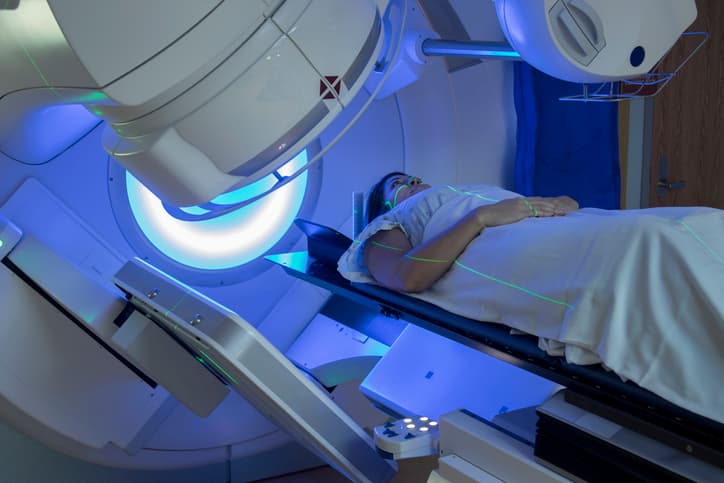
Radiation therapy equipment is a core therapeutic infrastructure in oncology and has evolved over the past two decades from conventional conformal delivery to advanced external-beam techniques such as IMRT, IGRT, and VMAT, as well as specialized modalities including SRS, SBRT, adaptive radiotherapy (ART), brachytherapy, and particle therapy. The most common form of radiation oncology is external beam radiotherapy delivered by a medical linear accelerator (linac). A linac generates a high-energy photon beam and delivers radiation while the patient lies on the treatment couch; the gantry rotates around the patient to deliver beams from multiple directions, improving conformity to the tumor and reducing dose to surrounding tissue. Linacs can also deliver electron beams for superficial targets where limited penetration is advantageous.
IMRT is an advanced form of external beam radiotherapy in which the intensity within the radiation field is modulated, typically using multileaf collimators, so the dose distribution more precisely matches the tumor volume. This allows higher dose to the target and lower dose to nearby healthy tissue compared with older techniques, enabling individualized plans with millimeter-level geometric control when imaging, immobilization, and motion management are adequate. IMRT is widely used across major tumor sites including head and neck, breast, prostate, pancreas, lung, liver, gynecologic malignancies, and central nervous system tumors, and is considered a global standard of care in many settings.
VMAT is an evolution of IMRT in which dose is delivered while the gantry rotates, with the system simultaneously optimizing gantry speed, dose rate, and multileaf collimator positions. This enables highly conformal dose distributions similar to IMRT, often with shorter treatment times and improved delivery efficiency. IGRT complements IMRT, VMAT, SRS, and SBRT by using in-room imaging to align the patient and target immediately before and, when necessary, during delivery, accounting for setup variation and anatomical change. By improving geometric accuracy, IGRT supports tighter margins and better sparing of healthy tissue, and is widely adopted in contemporary practice.
SRS and SBRT, often grouped as stereotactic radiotherapy, are ablative techniques that deliver high dose per fraction in a small number of fractions, using precise immobilization, advanced image guidance, and highly conformal beam arrangements to concentrate dose in the target while minimizing exposure to surrounding tissue. These approaches are increasingly used for both malignant and benign lesions across the body where local control and dose falloff are clinically valuable.
Radiation therapy equipment spans medical linear accelerators, Gamma Knife systems, CyberKnife robotic radiosurgery, helical tomotherapy platforms, and proton and heavy-ion therapy systems. Among these, the medical linear accelerator remains the most widely deployed globally. Across the clinical workflow, target delineation, prescription design, plan optimization, and quality assurance materially affect outcomes. Because contouring and planning depend on clinician and physicist judgment and because patients vary in anatomy and motion, uncertainty arises from factors such as inter-observer contour variability, organ motion, and setup and positioning errors. Variations in immobilization, daily anatomy, and imaging conditions across a treatment course further complicate reproducibility, which is why modern radiotherapy places increasing emphasis on image guidance, motion management, adaptive workflows, and tighter QA regimes.
Proton and heavy-particle therapy represent another major modality. Proton therapy uses protons accelerated by a cyclotron or synchrotron rather than photons from a linac. The proton depth-dose characteristic, commonly described by the Bragg peak, enables reduced entrance and exit dose compared with photons in many geometries, which can be advantageous for certain tumors, particularly pediatric cancers and lesions near critical structures. Pencil beam scanning is an advanced delivery approach that “paints” dose spot-by-spot and can be configured as intensity-modulated proton therapy (IMPT), often improving conformality relative to passive scattering. Heavy-ion therapy most commonly refers to carbon-ion radiotherapy in current clinical practice; carbon ions exhibit higher linear energy transfer and higher relative biological effectiveness than photons and, in many contexts, higher than protons, which may allow improved control in select radioresistant tumors and may reduce fraction count in some protocols. Heavy-ion systems are operationally complex and capital intensive, with longer clinical and commissioning pathways, and therefore follow a different adoption curve than linacs.
From an indication perspective, demand is concentrated in high-burden solid tumors that drive both volume and equipment utilization. Lung cancer remains the largest single treatment segment, moving from about US$1.08 billion in 2026 toward US$1.54 billion by 2030, reflecting both incidence and the intensity of motion and targeting requirements that reward modern planning and delivery capability. Breast cancer follows at about US$917 million in 2026 and rises toward US$1.29 billion by 2030, with continued emphasis on throughput, reproducibility, and workflow efficiency in high-volume clinics. Colorectal and prostate cancers remain substantial and durable pools, with 2026 revenue around US$722 million and US$609 million respectively, benefiting from broad treatment penetration and standardized care pathways that often translate into multi-year replacement and upgrade demand once a center commits to a platform.
Competition in radiotherapy remains bifurcated: the conventional linac segment is dominated by a small number of global leaders with deep installed bases, while Asia Pacific, particularly China, is seeing more active domestic challengers competing on tender execution, localization, and service footprint. Particle therapy sits on a different economic curve, defined by higher project complexity, longer sales cycles, and more stringent site readiness and clinical program requirements, which tends to concentrate activity among a limited set of specialized suppliers and well-capitalized providers. Across 2026–2032, supplier differentiation is increasingly determined by execution quality and ecosystem depth rather than hardware alone: software integration, adaptive workflows, service uptime, upgrade pathways, clinical application support, and the ability to deliver predictable throughput under real-world staffing constraints are becoming decisive factors in both winning tenders and sustaining margins.